
Often in the past, I would ask something like “is the design ready?” Implicit in this question was the assumption that “design” was just a thing, a piece of meatloaf cooking in the oven that I waited for eagerly.
Maybe I was expecting evidence of a “good design” in the form of a nice document or a tidy set of mockups. I got smarter, and older, and realized that it would be quite useful to make the distinction between design(noun) and design(verb).
Because a document, mockup or whatever physical evidence the team wanted to put forward was never enough evidence of good design(verb).
Like when my friend showed me all the souvenirs and pics of her trip to India. Was this evidence of the depth and quality of her journey? Not really, souvenirs and pics were just an output.
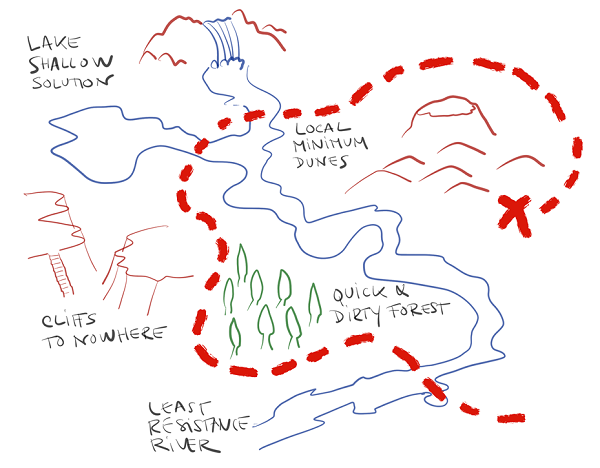
Because the essence of design(verb) is exploration. A good designer is a trusted scout that explores the complexity jungle ahead, hacking a path with her machete. Eventually the rest of the team will follow this path to widen it and flatten it, making it a usable road. The exploration is, unfortunately, invisible and ineffable.
Dan was one of my best designers ever. One day I found him sitting at his desk, hunched over, his glasses set aside. He cradled his face inside his palms, as if weeping. His thumbs were stretched over his ear holes to shield them from noise. Random pieces of paper and a pencil laid in front of him. He was absolutely still as I walked by. I had to smile. I knew exactly what he was doing, and how far removed his mind was from that desk. That is design.
Sometimes, when I get together with another suitable mind in a room to attack an idea using a whiteboard, something powerful happens. An unexpected energy is summoned and the creative intensity of the back and forth discussion becomes almost physical. We draw and re-draw on the whiteboard, wiping the dry-erase marker with our fingers or sometimes with our whole hand, as if merely reaching for the eraser could put at risk the very thing that we were about to draw. After a while, both of us sit silently for minutes watching the whiteboard–and do it all again. That is design.
Conceptual Integrity
“I will contend that conceptual integrity is the most important consideration in system design. It is better to have a system omit certain anomalous features and improvements, but to reflect one set of design ideas, than to have one that contains many good but independent and uncoordinated ideas.”
The Mythical Man Month – Frederick Brooks (1975)
For evidence that deep exploration/design has taken place, I now scrutinize the conceptual integrity of the result.
The point is: whatever system you are creating must be obvious to use to be successful in the long run. And obvious-to-use systems are exceptionally well put together conceptually.
Because there is no ease of use without conceptual integrity. You just cannot layer UI/UX on a system with poor conceptual integrity to fix this deficiency.
So, “Is the design ready?”
Well, can you answer yes to the questions below?
Did you look at what others have already done in similar situations?
Because nothing is original.
“What is originality?
– William Ralph Inge
Undetected plagiarism.”
Did you let it rest, by this I mean did you move away for a period of a day or two before coming back to the problem?
Because we can become creatively fatigued and miss key turns in the road. I have not found a way to force creativity. Innumerable times a key distinction or clever shortcut came to me only after loosening my mental grip on the problem. I am sure this must have happened to you too.
Did you explain the mental model you created to yourself? Was it easy?
This is called “self-explanation” and requires talking to yourself in the second person, like “…then you take this box and…”
Did you run it by one or two smart and deep-thinking peers? How much explaining was needed until they got it?
Put that self-explanation to test. If you cannot put it clearly, then YOU are not thinking clearly.
During the design process did you at any point say to yourself this is stupid/impossible?
This is a good sign you went deep and a sign of humility. If everything looks easy and trivial, it is quite possible it is trivial only to you. Do not be like the brilliant professor that always thinks everything he says is splendid but leaves the listener, or in our case, the system user, in a daze.
1 thought on “Design is a Verb”
Comments are closed.