
“About 20,000 emails,” I’d say rolling my eyes, “that’s how many I get in one year—I counted.”
Then I’d plunge into a pool of gloom and commiserate with my colleague about how email is destroying our productivity, our creative time, our personal peace and the global supply of fresh salmon. I’d go on rambling and fantasizing about a world that works without email—I could have fantasized as well about a world that works without humans. Because as much as I’d like to shoot the ”message”, email fatigue has nothing to do with the platform, but the humans, ahem, like you and I, that (ab)use it.
I had to get over it
Email is not going away. The articles that claim “email is dead” usually cite the legions of younger generations that turn their nose up at email and instead communicate using the newer platforms like SMS, WhatsApp, iMessage, Skype, Facebook Messenger, Twitter, Slack…
I accept that for informal communication and gossip, using email is silly. I do not want an email for: “Dinner tonight?”, “Server down. Call me”. The short-message platforms like the ones above are not replacing email. They are providing better methods for quick, informal or urgent communication.
To say that email is dead because younger generations entering the workforce dislike email, is to say that business in the future will be conducted without formal communication—because younger generations dislike formal communication. Nonsense.
More email users, not less
Email is growing steadily and faster than the world population. See below.
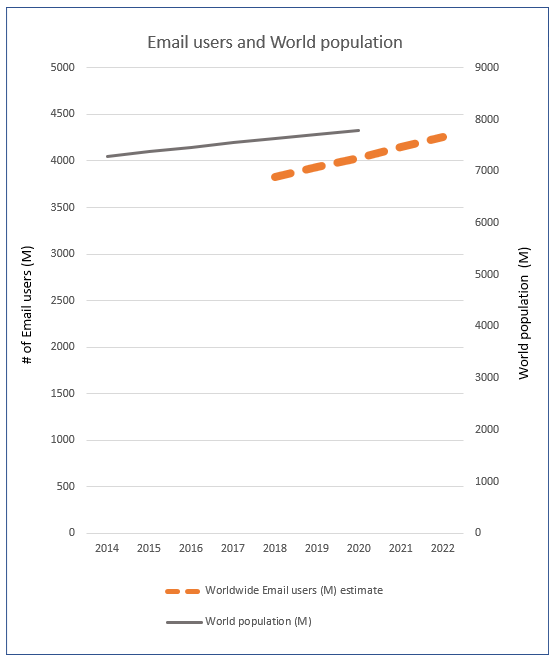
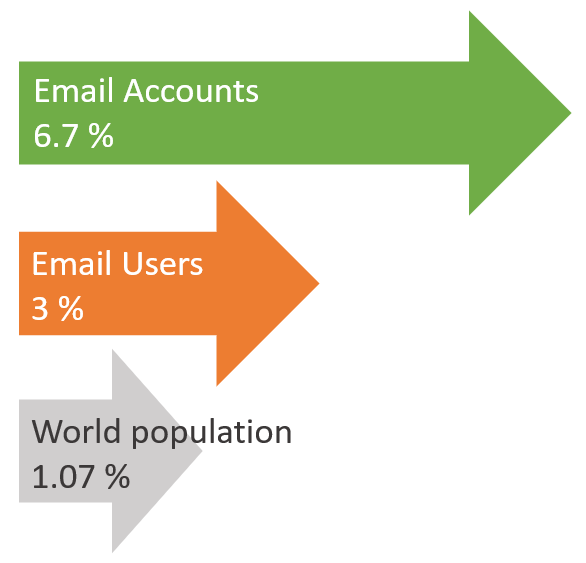
Sources: United Nations – Department of Economic and Social Affairs, Population Division (2019). World Population Prospects 2019, Online Edition. Lifewire – How Many People Use Email Worldwide?. Statista – Number of active e-mail accounts worldwide from 2014 to 2019 (in millions)
The increase of mailboxes can be explained, in part, because more people have multiple email addresses; but the absolute count of email users is growing too—at a rate three times faster (3%) than the general population (1.07%)
Email enabled work and flows
Most internet apps and software trust email to notify, collect and bring work to your attention. Here are some personal examples of what I generously call “workflow” type emails:
- An agile tool sent me 15~30 email updates daily about issues that I had submitted.
- My bill has not yet arrived.
- My electronically notarized document was not accepted by the interested party.
- My flight was booked, and here are all the details.
- A not-so-friendly reminder from the department of state that the renewal of my business registration is overdue.
You get the idea.
Did you write that down?
Aside from enabling “work and flow,” there are even more use cases in which email is the most natural tool we have today for semi-formal and formal communication. For example:
- List of actions we agreed in our last meeting
- Here is the contract ready for your review, sign it if you do not have changes
- List of people interested in attending the webinar
- Please find below the list of objections from the customer and my itemized responses.
A reason to invest
Considering the growth of email users, and the abundance of use cases for email, to say that “email is dead” appears to me just a shock technique to get your attention, not a fact-based conclusion.
I made peace with the fact that email is not “dead” and that it will be here for a while; and that email overload could continue to trigger stress in my day.
I concluded that it pays off for me to stop “shooting the message” and instead pay attention, look for and learn ways to refine, improve and optimize how email is used by me and my business.
Like every professional I know, I have my own quirky, long-curated techniques and tools to address email overload that I feel very proud of. I will not talk about those here. Just let me point out that, most of the time, I found that the best investment was in tuning my own expectations when I face my emails, and seeking to understand others motivations before I react.
Because the core of the “email problem” is not solved with tools, but by diving into the human-ity of it.
So, tools and techniques aside, I will share these over-arching personal principles that worked for me to be more at peace with email:
#1 DO: HONOR IT
I honor email with attention. I do this by reading and processing my emails at a time and space (mental and physical) in which processing emails is right for me. This honors my energy and the energy of the sender. Typically, this is when I am at a desk, in a quiet place, or with my headset on, after I cracked my knuckles and I said to myself: “ok, bring it on.”
Note to reader: if you cannot find a mental/physical place like this, your problem is not email.
#2 DO: SCAN IT
There is a context in which I ingest email that does not entail full attention: when I scan.
Yes, to scan is ok. If it is a scan. For me, a scan is a quick visual sweep looking for new items that appeared on the radar screen a.k.a. inbox; I may scan as often as every 1 hour, but no more often than that. Are there any missiles headed my way? I only look for that crucial message sitting in my inbox that will totally change how I originally planned to attack my day.
Before the scan, I prepare myself mentally to see stuff that could be triggering or emotionally charged to me, but that I will happily defer because of the next principle.
And then, I relax—real emergencies will reach me via a text or a phone call or someway.
#3 DO NOT: BE REACTIVE
Mind like water. I am the one in control.
My reaction to that email message says as much about me as it says about the sender that triggered me. Unlike verbal communication, 90% of context and emotional intention is lost when writing and reading a piece of text written a hurry. I give extraordinary leeway to the motivation I attach to any email communication. I take literal advantage of the separation between stimulus and response. I regretted every time I did not do this.
I am also mindful of a pervasive negative reaction that sometimes wells up inside me. A reaction towards the workload implied by so many different tugs at my attention. Then, it helps me to focus on #4 below.
#4 DO NOT: BE PERFECT
I do not respond to every email in a quick fashion. Why? Because I cannot, I should not.
- Because email begets email, I am very careful about what and how I choose to respond—I favor silence over squabble.
- I use my judgement; I select and respond first to the messages that will have maximum return for my energy.
- If needed, I apologize for not being quick at responding,
- I reply with an acknowledgment that I have added “this” to my work system and I will get to it (later).
- Most humans are understanding if I let something slip through the cracks; when they are not, I refer to #3.
- I am limited by how much I can get done effectively. If I am truly being asked to do more than what I can, then I am not the problem: a bigger system that I am a part of needs improvement.
• • •
Yes, at a clip of thousands of emails a year I can hate email, but I love effective, clear and concise communication more. Today, the cheapest, most prevalent tool I have to achieve this communication is email.
Instead of waiting for the internet fairy to make email go away, I will focus my energy on finding better and more productive ways to communicate using the existing tool. If you find yourself frustrated with email like me, I suggest you do the same.